Hydrochloric acid About
Chemical Description of Hydrogen Chloride (HCl)
Hydrogen Chloride ((HCl)) is a diatomic molecule composed of one hydrogen atom and one chlorine atom linked by a polar covalent bond.
- Physical Form: At room temperature, it is a colorless, non-flammable gas with a sharp, pungent, and irritating odor.
- Aqueous Form: When dissolved in water, the gas completely dissociates into hydronium ((H_{3}O{+})) and chloride ((Cl{-})) ions. This solution is known as hydrochloric acid, a highly corrosive, monoprotic strong mineral acid.
Frequently Asked Chemistry Questions and Answers on HCl
Section 1: Physical Properties & Structure
Q1: What is the molecular mass of HCl?
- Answer: 36.5 amu (or g/mol). Calculated by adding the atomic mass of Hydrogen (1 amu) and Chlorine (35.5 amu). [1, 2]
Q2: Why is HCl classified as a polar covalent compound?
- Answer: Chlorine is significantly more electronegative than hydrogen. It pulls the shared pair of electrons closer to itself, creating a partial negative charge (delta ) on chlorine and a partial positive charge (delta ) on hydrogen.
-
Q3: Dry HCl gas does not change the color of dry blue litmus paper, but hydrochloric acid turns it red. Why?
- Answer: Dry (HCl) gas exists as molecules and contains no free hydrogen ((H{+})) or hydronium ((H_{3}O{+})) ions, which are responsible for acidic behavior. In water, it ionizes completely, releasing the (H{+}) ions that cause the acidic color change. [, 2, 3, 4, 5]
Section 2: Laboratory Preparation & Collection
Q4: Which acid is used in the laboratory preparation of HCl gas, and why?
- Answer: Concentrated Sulfuric acid ((H_{2}SO_{4})) is preferred. It is a high-boiling, non-volatile acid that easily displaces the volatile (HCl) gas from sodium chloride ((NaCl)) without contaminating the gas with its own vapors. [1, 2, 3, 4, 5]
Q5: Why must the temperature during laboratory preparation be kept below 200C? [
1]
- Answer: If the temperature exceeds 200C, a hard crust of sodium sulfate ((Na_{2}SO_{4})) forms inside the glass flask. This crust sticks to the glass.
Q6: Why can't quicklime ({CaO}) or phosphorus pentachloride be used to dry HCl gas? What is used instead?
- Answer: Quicklime is basic and will chemically react with the acidic (HCl) gas to form salt and water. Instead, concentrated sulfuric acid (({H}_2{SO}_4)) is used as a drying agent because it absorbs moisture without reacting with (HCl).
Q7: How is HCl gas collected in the lab, and why?
- Answer: It is collected by upward displacement of air because it is roughly 1.28 times heavier than air. It cannot be collected over water because it is extraordinarily soluble in water.
Versatile Industrial ApplicationsHydrochloric acid plays an essential role in multiple industries, including metal refining, water treatment, and food production. It is most commonly used to remove rust from steel (pickling), adjust pH levels, produce chlorides, and act as both a powerful laboratory reagent and an industrial cleaning agent. Its complete miscibility and high reactivity make it invaluable for many chemical processes and manufacturing needs.
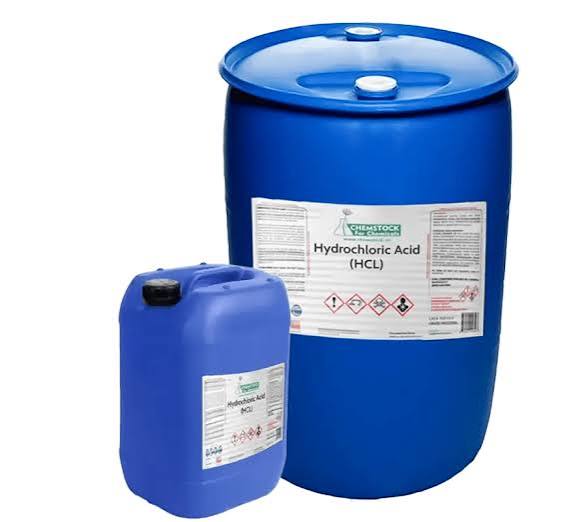
Safe Handling and StorageDue to its high corrosiveness toward metals and tissues, hydrochloric acid must be stored in tightly closed HDPE drums or carboys in cool, well-ventilated areas away from incompatible materials. Prolonged exposure is hazardous, so ensure proper PPE, such as gloves and goggles, is used during handling. Adhering to safety protocols extends the shelf life to two years and preserves product quality.
FAQ's of Hydrochloric acid:
Q: How should hydrochloric acid be safely stored and handled?
A: Hydrochloric acid should be stored in tightly sealed HDPE drums or carboys in a cool, well-ventilated location, away from alkalis and oxidizers. Always wear appropriate personal protective equipment like gloves and goggles when handling, as the solution is highly corrosive and can cause burns to skin and tissue.
Q: What are the primary applications of hydrochloric acid in industry?
A: This acid is widely employed for industrial cleaning (steel pickling), pH adjustment in water treatment, and as a reagent in the production of chlorides and various chemicals. Additional uses include laboratory analysis, cleaning agents, and certain food processing applications (when used in food grade).
Q: When is hydrochloric acid typically used in water treatment processes?
A: Hydrochloric acid is introduced during water treatment to lower and control the pH level, ensuring optimal conditions for downstream purification or chemical reactions. Its strong acidity makes it effective for rapid pH adjustment.
Q: What precautions should be taken when transporting hydrochloric acid?
A: Transport hydrochloric acid in approved HDPE containers (UN 1789), and ensure the containers are tightly closed. Label all containers correctly according to Hazard Class 8 (corrosive) and avoid exposure to incompatible substances to prevent dangerous reactions or leaks.
Q: Where can hydrochloric acid be sourced and in what packaging options?
A: Hydrochloric acid is available from manufacturers, suppliers, and traders in various grades-industrial, laboratory, and food. Standard packaging includes HDPE drums or carboys with common capacities like 35L, 50L, and 200L, conforming to international transport and storage standards.
Q: What are the main benefits of using hydrochloric acid in industrial applications?
A: Its strong reactivity, complete water solubility, and effectiveness as a cleaning and pH-adjusting agent make hydrochloric acid critical to efficient manufacturing, water treatment, and chemical synthesis, thus improving both productivity and process control.





 Send Inquiry


 Send Inquiry